Contact us

Advancing our understanding of fluid behavoiur to solve real-world challenges. Through advanced research, we explore complex fluid systems and generate new knowledge across a wide range of applications.
The Flow Technology Department conducts research on fluid flow, transport processes, and related physical phenomena across a wide range of applications. Our core expertise is in multiphase flow, CO₂ transport, and fluid characterization. We also apply our knowledge to challenges in medicine, geotechnics, environmental research, and other fields where fluid behaviour plays an important role. Combining advanced laboratory facilities with numerical modelling and software development, we generate new knowledge, experimental data, and innovative tools for understanding complex systems. Our work is carried out through national and European research programs and in close collaboration with industry, ensuring that research results are translated into real-world impact.
Description and background
The Flow Technology Department has a long history of combining experimental research with mathematical modelling and software development to advance the understanding of complex flow systems. The department is particularly known for its role in the development of OLGA, the world’s leading multiphase flow simulator, which has been recognized as one of Norway’s most important technological innovations and has played a key role in the development of subsea production technology.
Our activities are built around two complementary pillars: experimental investigations and numerical modelling. Together, these capabilities enable us to develop, validate, and improve simulation tools and engineering methods for a wide range of flow-related challenges.
The department operates advanced laboratory facilities that support both research and industrial innovation. These facilities are used to generate high-quality experimental data, validate models, test equipment, and demonstrate new technologies. Through decades of experience, we have developed a strong reputation for bridging fundamental science and practical applications.
Our multidisciplinary team consists of scientists and engineers with expertise spanning fluid mechanics, applied mathematics, physics, chemistry, thermodynamics, and computational science. This combination of backgrounds enables us to tackle complex problems from multiple perspectives and deliver robust, science-based solutions.
Rooted in Norway’s strong tradition of energy technology, the department has continuously expanded its expertise and application areas while maintaining a focus on advancing knowledge of flow and transport phenomena.
Research Activities Area
The Flow Technology Department conducts research within fluid flow, transport processes, heat transfer, and thermodynamic phenomena, with a strong focus on experimental and numerical studies of complex systems. Our work is primarily centred on oil and gas, and CO₂ multiphase flow transport, supported by advanced laboratory facilities and modelling tools that enable detailed investigations across a wide range of conditions.
CO₂ transport and flow behaviour are essential to carbon capture and storage (CCS) technologies. Our CO₂ loop is designed to replicate operating conditions relevant to both transport and injection, making it a key facility for understanding flow behaviour in carbon management systems. We conduct experiments with both pure CO₂, and CO₂ containing impurities under controlled conditions.
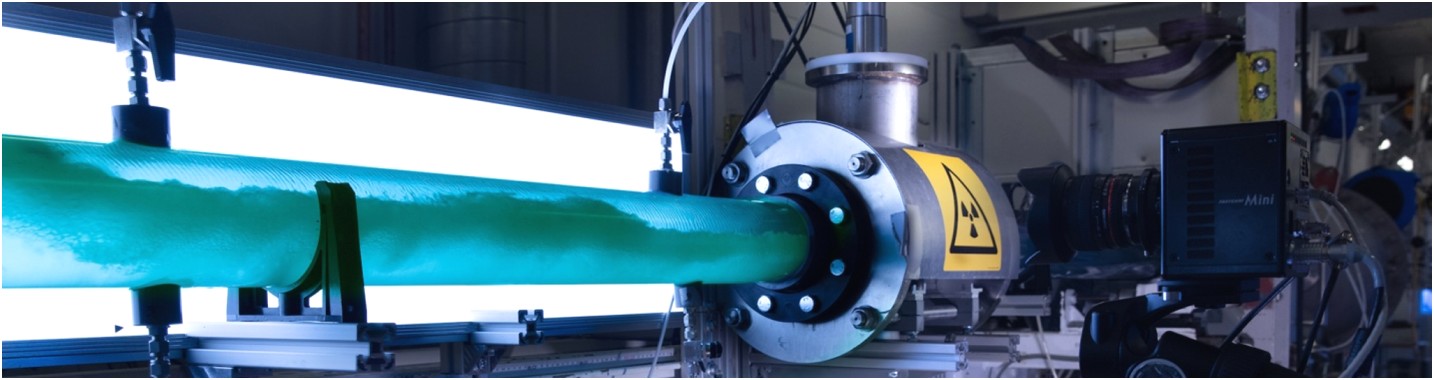
Multiphase flow research focuses on systems involving two or three phases, typically oil, water and gas, as well as flows containing solid particles. Our multiphase flow loop enables controlled experiments across different flow regimes and uses high-density gas to reproduce conditions relevant to high-pressure natural gas systems.
We conduct CO₂ and multiphase flow research focused on transport phenomena relevant to CO₂ and petroleum systems. We perform experiments across a wide range of flow configurations and operating conditions. Our facilities include pipes of different diameters, enabling systematic studies of scaling effects and improving the transferability of results from laboratory settings to real-world transport systems.
Experimental work is closely integrated with numerical modelling and simulation. We develop and apply numerical models to study flow behaviour, phase interactions and transport mechanisms across complex systems. Our work includes both in-house coding and commercial software, enabling detailed analyses of multiphase flow, CO₂ transport and related energy processes under realistic conditions.
In addition to flow simulation, we use computational methods to support the interpretation and analysis of experimental measurements, including advanced instruments and imaging data. By combining experiments, numerical models and simulation tools, we improve physical understanding, validate predictive capabilities and strengthen confidence in the design and operation of energy and carbon management systems.
Across all research areas, we combine experimental data, theoretical understanding, numerical modelling and simulation to develop improved predictive tools and deepen understanding of complex flow systems. This integrated approach supports both fundamental research and industrial applications in energy, process engineering and carbon management.
Laboratories
Well Flow Loop – Multiphase Transport Lab https://ife.no/en/laboratory/well-flow-loop-2/
FALCON – CO2 Transport Lab https://ife.no/en/laboratory/falcon-co2-flow-loop/
CSIR – Fluid Characterization Lab https://ife.no/en/laboratory/colloid-interface-and-fluid-research-laboratory-cirlab/
Selected National Projects
MIND, 2026-2030
KSP research project focused on improving multiphase flow prediction in downward and undulating pipelines, where current models are limited by scarce experimental data. The project combines large-scale flow experiments and open-source model development to better predict flow regimes, slugging, pressure drop, and phase behaviour, improving efficiency and reducing emissions in oil and gas transport.
Partners: SINTEF, LedaFlow, SLB, OKEA, and TotalEnergies
MUST, 2022-2026
KSP research project focused on improving multiphase flow prediction in steeply inclined wells, risers, and flowlines, where current simulation models have high uncertainty due to limited experimental data. The project performs large-scale flow experiments and develops improved scaling rules and physical understanding to strengthen design and operation of offshore production systems.
Partners: UiO, IFE, SLB, and Equinor.
MultiFlow SUITE, 2021-2026
KSP research project combining multiphase flow analysis and AI/ML to improve monitoring and optimization of oil and gas transport systems. It develops hybrid models that combine physics-based simulators with experimental and operational data and ML models for condition monitoring, tie-in design, and virtual flow metering.
Partners: IFE, SINTEF, NTNU, SLB, TechnipFMC, LedaFlow Technologies, and Vår Energi
NCS2030, 2022-2029
National Centre for Sustainable Subsurface Utilization of the Norwegian Shelf is a research centre with over 30 national and international partners. The research is focused on sustainable subsurface use of the Norwegian Continental Shelf, combining efficient hydrocarbon production with CO₂ storage, hydrogen, geothermal energy, and digital decision tools to support net-zero goals. The centre develops new methods for low-emission production, subsurface modelling, uncertainty management, and digitalization to improve energy recovery and storage.
Website: https://www.uis.no/en/ncs2030
Selected European Projects
IMPACT-EUCO2, 2026-2029
European research project targeting improved prediction and management of CO₂ flow behaviour in transport and injection systems for CCS, with particular focus on how impurities influence thermodynamics, transient operation, and system performance. The project combines experimental work, modelling, and validation against industrially relevant conditions to strengthen the reliability of CO₂ pipeline and storage design under real-world compositions. The consortium brings together a broad international network of research institutes, universities, and industry partners across Europe, with IFE as a participating partner, working closely with industry to ensure direct application of results in future CCS infrastructure.
Website: https://cordis.europa.eu/project/id/101269030
ENCASE, 2023-2026
European research project focused on improving CO₂ transport and injection in CCS systems, combining experiments, modelling, and industrial validation to better understand multiphase and dense-phase CO₂ flow. The project addresses key challenges such as transient flow behaviour, impurities, and system-scale transport dynamics, aiming to reduce uncertainty in the design and operation of CO₂ pipelines and wells. The centre brings together a broad international consortium of research institutes, universities, and industry partners across Europe, with IFE as coordinator, working closely with industry to ensure direct application of results in future CCS infrastructure.
Website: https://www.encase-eu.com/
Selected Scientific Publications
Boeije, Christian S., Erika K. Lindstrøm, Ole Petter Maugsten, Olaf Skjæraasen, and Jan Nossen. “Flow Regimes and Transitions in Three-Phase Flow Through Steeply Inclined Pipes.” International Journal of Multiphase Flow (2026): 105837. https://www.sciencedirect.com/science/article/pii/S0301932226002387
Skartlien, Roar, Jan Nossen, G. W. Johnson, and T. K. Kjeldby. “A three-phase dispersion profile model for stratified pipe flow: Effects of gas bubbles on the distribution of oil and water droplets.” Geoenergy Science and Engineering 244 (2025): 213469. https://www.sciencedirect.com/science/article/pii/S294989102400839X
Eide, Per Kristian, Ragnhild Marie Undseth, Øyvind Gjertsen, Lars Magnus Valnes, Geir Ringstad, and Erika Kristina Lindstrøm. “Significant individual variation in cardiac-cycle-linked cerebrospinal fluid production following subarachnoid hemorrhage.” Fluids and Barriers of the CNS 21, no. 1 (2024): 85. https://link.springer.com/article/10.1186/s12987-024-00587-9
Smith, Lisa, Vidar Skulberg, Lili Zhang, Ivar Sjaastad, and Emil Espe. “The effects of geometry on stiffness measurements in high-field magnetic resonance elastography: A study on rodent cardiac phantoms.” Journal of the Mechanical Behavior of Biomedical Materials 133 (2022): 105302. https://www.sciencedirect.com/science/article/pii/S1751616122002156
Hammer, Morten, Han Deng, Lan Liu, Morten Langsholt, and Svend Tollak Munkejord. “Upward and downward two-phase flow of CO2 in a pipe: Comparison between experimental data and model predictions.” International Journal of Multiphase Flow 138 (2021): 103590. https://www.sciencedirect.com/science/article/pii/S0301932221000380
Sjöblom, Johan, Sameer Mhatre, Sébastien Simon, Roar Skartlien, and Geir Sørland. “Emulsions in external electric fields.” Advances in Colloid and Interface Science 294 (2021): 102455. https://www.sciencedirect.com/science/article/pii/S0001868621000968
Seiersten, M., A. Dugstad, J. Nossen, and O. Sendstad. “Top of line corrosion in gas-condensate pipelines.” In IOP Conference Series: Materials Science and Engineering, vol. 1201, no. 1, p. 012082. IOP Publishing, 2021. https://iopscience.iop.org/article/10.1088/1757-899X/1201/1/012082/pdf
A. Hiorth, J. Sagen, J. Nossen, A. Lohne, J. L, Vinningland, B. Antonsen, E. Brendsdal, T. Sira: IORSim – Adding more physics and chemistry to reservoir simulators. IOR Norway 2021, UIS 26-28 April
Farokhpoor, Raheleh, Lan Liu, Morten Langsholt, Karin Hald, Joar Amundsen, and Chris Lawrence. “Dimensional analysis and scaling in two-phase gas–liquid stratified pipe flow–Methodology evaluation.” International Journal of Multiphase Flow 122 (2020): 103139.. https://www.sciencedirect.com/science/article/pii/S0301932219305075
Skjæraasen, Olaf, and Netaji R. Kesana. “X-ray measurements of thin liquid films in gas–liquid pipe flow.” International Journal of Multiphase Flow 131 (2020): 103391. https://www.sciencedirect.com/science/article/abs/pii/S0301932220305000
Bendiksen, Kjell H., Morten Langsholt, and Lan Liu. “An experimental investigation of the motion of long bubbles in high viscosity slug flow in horizontal pipes.” International Journal of Multiphase Flow 104 (2018): 60-73. https://www.sciencedirect.com/science/article/abs/pii/S0301932217307735